
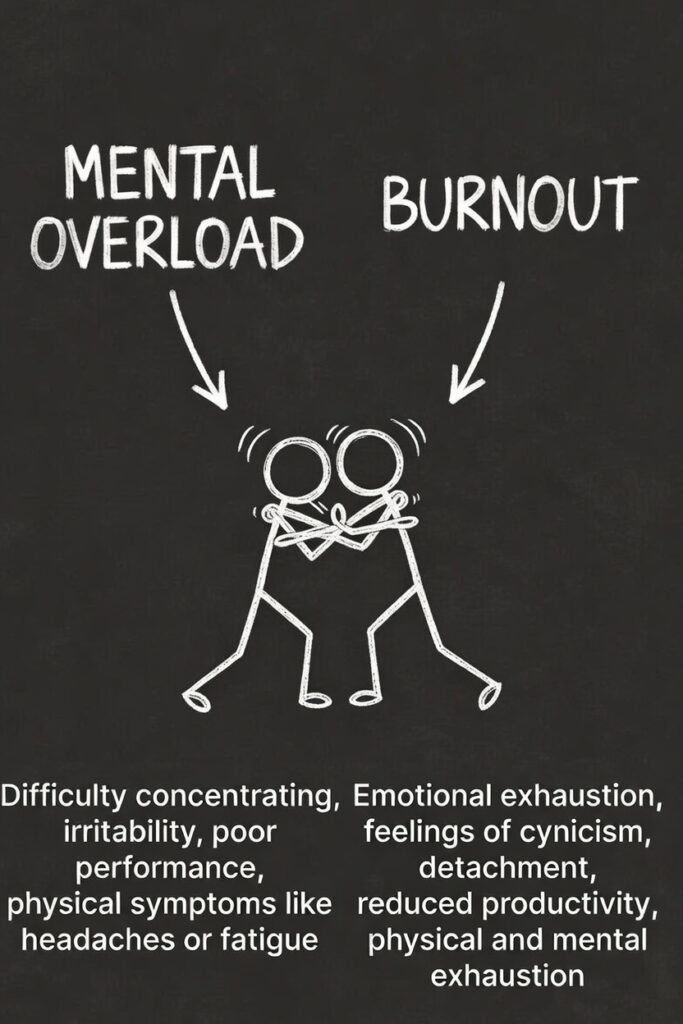
Mental Overload vs Burnout: What’s the Difference? Mental overload and burnout are often used interchangeably. They feel similar, appear at the same time, and both create exhaustion that’s hard to explain.
Mental overload vs. burnout is one of the most confusing experiences people face as exhaustion sets in.
But they are not the same experience.
Understanding the difference between mental overload and burnout helps you choose the right response. Without that clarity, many people rest when change is needed — or push through when simplification would help.
Both experiences involve fatigue, reduced focus, and the sense that everything requires more effort than it should.
The difference isn’t how they feel.
It’s what’s causing them.
Mental overload occurs when your brain has too many open loops.
Too many decisions.
Too many tabs.
Too many things that need remembering.
Your attention becomes fragmented. You jump between tasks without finishing them. Even simple decisions feel effortful because your cognitive bandwidth is already full.
You’re not emotionally empty — you’re mentally crowded.
Mental overload often appears during busy periods, life transitions, or environments that require constant responsiveness. Notifications, deadlines, multitasking, and responsibility all contribute.
This type of exhaustion is primarily cognitive. The system is overstimulated rather than depleted.
Because of that, mental overload often improves with rest, simplification, or stepping away. A quiet weekend, fewer decisions, or reducing inputs can restore clarity relatively quickly.
Burnout is different.
Burnout isn’t just having too much to do. It’s what happens when effort continues for long periods without enough recovery.
Instead of overload, burnout reflects erosion.
Over time, motivation fades. Focus becomes harder. Emotional engagement decreases. Tasks feel heavier even when they aren’t more complex.
Unlike mental overload, burnout affects both meaning and energy. You don’t just feel busy — you feel disconnected.
You can still function, but something underneath changes. Rest may temporarily reduce symptoms, but the underlying exhaustion persists.
Burnout develops gradually because output exceeds recovery for too long.
Mental overload and burnout often feel similar at first.
Both create tiredness, brain fog, and the sense that you’re mentally done. Both can make simple tasks feel harder than they need to be. Both reduce patience and increase irritability.
This overlap is why people misidentify what they’re experiencing.
Many people first encounter burnout as mental overload. They assume the solution is rest, better organisation, or productivity strategies.
Sometimes that works — which suggests overload.
Other times it doesn’t — which suggests burnout.
The key distinction is sustainability.
Mental overload is temporary congestion. Burnout is ongoing depletion.
One useful way to understand the difference is to think in terms of input versus output.
Mental overload comes from too much input. Information, decisions, interruptions, and demands arrive faster than they can be processed. The brain struggles to organise everything, creating mental clutter.
Burnout comes from too much output. Effort continues day after day without enough recovery, gradually reducing internal resources.
These changes often appear in the Early Signs of Burnout Most People Ignore
One is about volume.
The other is about duration.
As a result, the same person can experience both simultaneously. A busy environment creates overload, while prolonged responsibility creates burnout.
Recognising which is dominant guides what helps.
Rest helps one more than the other.
When mental overload is the primary issue, reducing stimulation often produces noticeable relief. Fewer decisions, less multitasking, and quieter environments allow cognitive systems to reset.
Clarity returns. Tasks feel manageable again. Motivation reappears.
With burnout, rest provides only partial improvement. You may feel slightly better after a break, but the underlying heaviness remains once normal routines resume.
This happens because burnout reflects structural imbalance rather than temporary strain.
Recovery requires adjusting expectations, boundaries, and pacing—not just increasing rest.
There are subtle signals that help distinguish the two.
Mental overload often looks like distraction, forgetfulness, difficulty prioritising, and the constant feeling of being behind. When pressure decreases, these symptoms improve relatively quickly.
Burnout often includes emotional disconnection, persistent fatigue despite rest, reduced reward from progress, and the sense that effort is no longer replenishing energy.
In overload, tasks feel chaotic.
In burnout, tasks feel heavy.
Overload overwhelms attention. Burnout drains capacity.
This distinction matters because the wrong strategy can prolong both experiences.
A calmer way forward begins with reducing self-judgement.
Neither mental overload nor burnout indicates weakness. Both are adaptive responses to sustained demand.
The goal isn’t to eliminate responsibility. It’s to restore balance between input, output, and recovery.
For mental overload, helpful steps often include simplifying systems, reducing decisions, limiting interruptions, and creating clearer priorities.
In burnout, the focus shifts toward sustainability—adjusting workload, introducing boundaries, allowing emotional processing, and rebuilding meaningful engagement.
Small, consistent changes tend to be more effective than drastic resets.
Many people move between overload and burnout over time. Busy periods create congestion. Long periods of responsibility create depletion.
Recognising the difference allows earlier intervention.
If clarity returns with rest, overload was likely the dominant factor. If exhaustion persists despite rest, burnout may be developing.
Awareness prevents escalation.
Mental overload asks for simplification.
Burnout asks for recalibration.
Both are signals, not failures.
Understanding what your system is responding to is the first step toward recovery — and toward building a pace that remains sustainable over time.
According to the World Health Organisation, burnout is linked to chronic workplace stress.
Link “World Health Organisation” to:
https://www.who.int/.
Pingback: Functional Burnout: When You’re Still Performing but Feel Empty – modernburnout.com.au