
Burnout personality changes can feel frightening. One of the most unsettling burnout symptoms is feeling like you are no longer yourself.
You might notice you are:
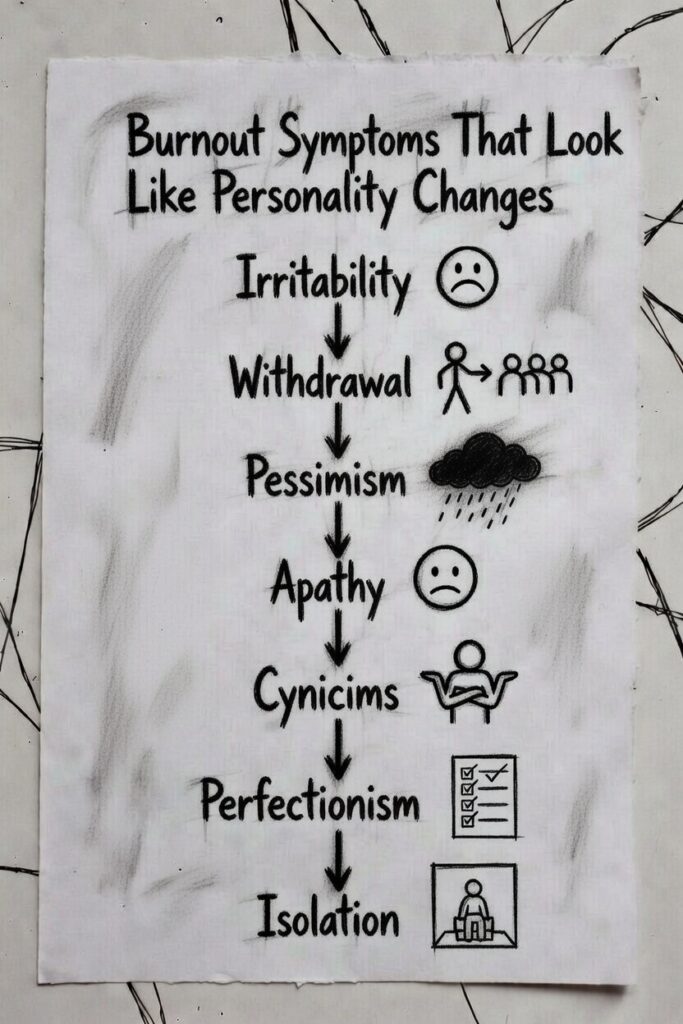
- More irritable
- Less patient
- Emotionally distant
- Detached from things you used to care about
It may feel as if your personality has changed.
But burnout does not change who you are. It alters your capacity.
Why Burnout Can Mimic Personality Changes
When the nervous system is under prolonged strain, it shifts into a protective mode. Energy narrows. Emotional range flattens. Tolerance decreases.
Burnout symptoms and personality changes often happen because identity is deeply tied to energy. When capacity drops, access to your usual traits becomes limited.
From the outside, it may look like:
“They’ve become colder.”
“They’re always annoyed.”
“They don’t seem like themselves.”
From the inside, it feels like:
“I don’t recognise myself.”
Common Burnout Symptoms That Feel Like Personality Shifts
The patient’s parent becomes short-tempered.
The enthusiastic worker becomes withdrawn.
The calm partner becomes reactive.
This isn’t character failure.
It’s exhaustion reshaping expression.
In high-functioning burnout, everything may appear stable on the outside while internal capacity is quietly collapsing. That’s why burnout personality changes are often misunderstood.
Are These Changes Permanent?
No. Burnout does not permanently alter your personality.
What appears to be a personality change is often your nervous system conserving energy. When stress remains high for too long, your system reduces emotional output to survive.
If you’re unsure whether this is burnout or something else, it may help to understand the difference between stress and burnout.
Burnout symptoms and personality changes are usually reversible once recovery begins.
Why Rest Alone Doesn’t Always Fix It
This is also why resting alone doesn’t always resolve personality changes associated with burnout. If internal pressure, guilt, or responsibility remains high, your system stays guarded.
This closely relates to why rest doesn’t work when guilt remains present. (Add internal link.)
Recovery requires more than stopping. It requires safety and structural adjustments.
How Recovery Restores Emotional Balance
Recovery begins when:
- Demands decrease
- Guilt softens
- Safety increases
- Capacity slowly returns
As capacity returns, so does your familiar self.
Burnout doesn’t erase who you are.
It temporarily hides parts of you behind survival mode.
Burnout personality changes can feel confusing and even alarming. When burnout symptoms build slowly, they can begin to look like shifts in your personality — irritability, emotional distance, or loss of motivation that wasn’t there before. One of the most unsettling parts of burnout is this:
You don’t feel like yourself.
You might become:
- More irritable
- Less patient
- Emotionally distant
- Detached from things you used to care about
It may feel as if your personality has changed.
But burnout doesn’t change who you are.
It alters the amount of capacity you have.
When the nervous system is under prolonged strain, it shifts into a protective mode. Energy narrows. Emotional range flattens. Tolerance decreases.
When Should You Be Concerned?
Burnout personality changes are usually reversible with rest and structural adjustments. However, if mood changes feel severe, persistent, or unrelated to stress, professional support may help rule out other causes.
Burnout symptoms can overlap with anxiety or depression, which is why context matters.
From the outside, it may look like:
“They’ve become colder.”
“They’re always annoyed.”
“They don’t seem like themselves.”
From the inside, it feels like:
“I don’t recognise myself.”
Burnout can mimic personality shifts because identity is deeply tied to energy. When capacity drops, access to your usual traits becomes limited.
This is especially common in high-functioning burnout, where everything appears stable on the outside, but internal capacity is quietly collapsing
The patient’s parent becomes short-tempered.
The enthusiastic worker becomes withdrawn.
The calm partner becomes reactive.
This isn’t character failure.
It’s exhaustion reshaping expression.
This is also why resting alone doesn’t always fix it when guilt remains. If pressure remains internally, your system stays guarded.
Recovery begins when:
- Demands decrease
- Guilt softens
- Safety increases
- Capacity slowly returns
As capacity returns, so does your familiar self.
Burnout doesn’t erase who you are.
It temporarily hides parts of you behind survival mode.
According to the World Health Organisation, burnout is linked to chronic workplace stress
According to the World Health Organisation, burnout is linked to chronic workplace stress.
Link “World Health Organisation” to:
https://www.who.int/.