
Burnout and Anger: What Irritability Is Really Saying
Not dramatic rage.
Not shouting.
Not losing control.
Just a short fuse.
Small things feel bigger than they should.
Noise feels sharper.
Questions feel intrusive.
Interruptions feel unbearable.
If you’ve noticed you’re more irritable than usual, it doesn’t automatically mean you’re becoming an angry person.
It may mean you’re burned out.
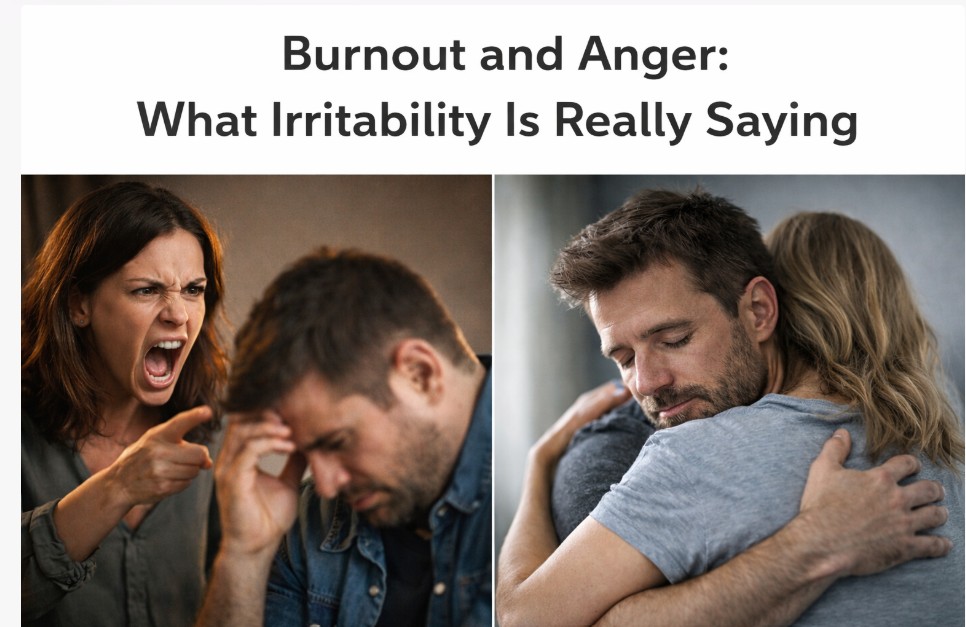
Burnout Doesn’t Always Look Like Exhaustion
Most people associate burnout with collapse.
But high-functioning burnout often looks different.
You’re still:
- Showing up
- Working
- Parenting
- Managing responsibilities
But internally, your nervous system is stretched to the limit.
When your capacity is low, even minor demands can feel overwhelming. Irritability becomes a signal that your internal resources are depleted.
Burnout isn’t just about tiredness. It’s about prolonged stress without recovery.
If you haven’t already, it may help to read What Burnout Really Feels Like (And Why Rest Alone Doesn’t Fix It):
Because irritability is often one layer of something deeper.
Anger as a Boundary Alarm
Anger is not always destructive.
At its core, anger is protective.
It says:
“This is too much.”
“This feels unfair.”
“I can’t keep absorbing everything.”
When you’ve been overextending yourself for too long — at work, at home, emotionally — anger can surface as a late-stage boundary alarm.
The problem is that burnout blurs boundaries.
You may:
- Say yes when you mean no
- Absorb other people’s emotions
- Carry mental loads that aren’t yours
- Avoid conflict to keep peace
Over time, unspoken resentment builds quietly.
Then one small trigger sets it off.
Not because the trigger is huge.
But because the buildup is.
Irritability Is Often Exhaustion in Disguise
When you’re well-rested and regulated, you can tolerate inconvenience.
When you’re burned out, tolerance shrinks.
Your nervous system shifts into survival mode:
- Hyper-alert
- Easily overstimulated
- Quick to react
You might snap at your partner.
Feel annoyed by your kids’ noise.
Get frustrated by emails that would normally feel manageable.
Afterwards, guilt follows.
But guilt doesn’t address the root cause.
Irritability is often your body saying:
“I don’t have the capacity for this right now.”
And if you constantly override that message, the irritability intensifies.
High-Functioning Burnout and Hidden Anger
Many people experiencing high-functioning burnout don’t see themselves as angry.
They see themselves as responsible.
Capable.
Reliable.
But inside, there’s a quiet tension.
You’re doing everything expected of you — but you feel under-supported, under-seen, or emotionally drained.
If this resonates, you might also relate to High-Functioning Burnout Is Still Burnout:
Because when you keep performing without replenishment, frustration builds under the surface.
Anger becomes the only visible crack.
The Link Between Suppressed Needs and Irritability
Burnout often develops in people who:
- Don’t want to disappoint others
- Take pride in being dependable
- Avoid asking for help
- Minimise their own needs
At first, this works.
You become the steady one.
But suppressed needs don’t disappear.
They turn into tension.
And tension eventually leaks out as irritability.
Not because you’re ungrateful.
Not because you don’t care.
But because your internal balance has been off for too long.
When Irritability Becomes a Pattern
Occasional irritation is human.
But if you notice:
- You feel constantly on edge
- Small requests trigger disproportionate reactions
- You fantasise about escaping everything
- You feel resentful toward people you love
It’s worth pausing.
Burnout-related anger isn’t about aggression.
It’s about overload.
And overload requires reduction — not shame.
What Irritability Is Really Saying
Instead of asking:
“Why am I so angry?”
Try asking:
“What is this irritation protecting?”
Often the answers are surprisingly clear:
- I’m overwhelmed.
- I haven’t had real rest.
- I feel unappreciated.
- I’ve been carrying too much alone.
- I need space.
Anger can be clarity in disguise.
But only if you’re willing to listen to it before it escalates.
You’re Not Becoming a Worse Person
One of the hardest parts of burnout-related anger is identity confusion.
You might think:
“I’m not like this.”
“I used to be calmer.”
“What’s wrong with me?”
But burnout changes your emotional tolerance.
It narrows your window of regulation.
That doesn’t mean your personality has changed.
It means your system is strained.
When pressure reduces, irritability often reduces too.
Which tells you something important:
The anger wasn’t the core issue.
The depletion was.
Practical First Steps (Without Overhauling Your Life)
You don’t need a dramatic reset.
Start smaller.
- Reduce one recurring demand if possible.
- Delay non-essential decisions.
- Add short, protected quiet time — even 10 minutes without input.
- Say one honest “not today” this week.
Burnout recovery isn’t about becoming softer.
It’s about becoming sustainable.
Anger softens when capacity increases.
Capacity increases when pressure decreases.
When to Take It More Seriously
If irritability is escalating into:
- Persistent hostility
- Verbal aggression
- Physical outbursts
- Feeling out of control
It’s important to seek professional support.
Burnout can overlap with anxiety, depression, and chronic stress disorders. There’s no weakness in getting help.
In fact, reaching out is often the first real boundary you’ve set in a long time.
Burnout and Anger Aren’t Character Flaws
Their feedback.
Your system is communicating.
Irritability is rarely random.
It usually means:
Something has been too much for too long.
Instead of suppressing or judging the anger, try understanding it.
Because behind irritability, there’s often exhaustion.
Behind exhaustion, there’s overextension.
And behind overextension, there’s usually someone who has been trying very hard to hold everything together.
If that sounds familiar, you’re not broken.
You might just be burned out.
If you send me your exact slugs, I’ll optimise:
- SEO Title (with power word + number)
- Meta description (under 160 characters with focus keyword)
- URL slug
- Snippet
- Image prompt + alt text
- Focus keyword placement fixes
Why Burnout Anger Often Targets the Wrong People
One of the most painful parts of burnout-related irritability is that it often shows up in the safest spaces.
At work, you might stay controlled.
With clients, you stay professional.
In public, you hold it together.
But at home — where you feel safest — the tension leaks out.
You snap at your partner.
You feel impatient with your kids.
You withdraw from conversations.
Not because they are the cause.
But because your nervous system finally drops the mask.
This creates a confusing cycle:
Burnout → Irritability → Guilt → More Emotional Drain → More Burnout.
And over time, the guilt can feel heavier than the anger itself.
But understanding this pattern is important.
Irritability is rarely about the moment.
It’s about accumulated strain.
The Physiology Behind Burnout and Anger
Burnout isn’t just emotional. It’s neurological.
When stress continues for too long, your body stays in a low-grade fight-or-flight state.
Cortisol remains elevated.
Your brain scans for problems.
Your patience decreases.
In this state, your threshold for stimulation drops.
Normal noise feels loud.
Normal requests feel intrusive.
Normal conflict feels threatening.
Your brain prioritises efficiency and survival — not empathy.
That’s why you might think:
“Why am I reacting like this?”
Because your system is conserving energy.
Anger is faster than reflection.
Irritability is quicker than vulnerability.
And when you’re depleted, your brain chooses the fastest route.
Burnout Anger vs. Healthy Anger
It’s important to distinguish something here.
Healthy anger is clear and focused.
It says:
“This behaviour isn’t okay.”
“I need a change.”
“I’m setting a boundary.”
Burnout anger is diffuse and reactive.
It says:
“Everything feels like too much.”
“I’m tired of all of this.”
“I don’t even know what I need.”
Healthy anger leads to action.
Burnout anger leads to withdrawal or shame.
The goal isn’t to eliminate anger.
It’s to understand whether it’s signalling a boundary — or signalling depletion.
The Hidden Resentment Layer
Many people experiencing burnout won’t admit they feel resentful.
Resentment sounds harsh.
But resentment often grows from imbalance.
If you consistently:
- Give more than you receive
- Support more than you are supported
- Listen more than you are heard
- Carry more than you share
Eventually, something inside starts keeping score.
Even if you don’t consciously want to.
That quiet scorekeeping turns into:
“I’m tired of being the strong one.”
“I’m tired of being the stable one.”
“I’m tired of being the responsible one.”
And when that feeling has nowhere to go, it surfaces as irritability.
Not because you don’t love the people in your life.
But because your internal balance has shifted too far outward.
Why Rest Alone Doesn’t Fix the Anger
You might think:
“I just need a weekend off.”
Rest helps exhaustion.
But burnout anger often requires more than sleep.
It requires adjustment.
Because if you rest for two days and return to the same overload, the irritability returns.
Burnout anger reduces when:
- Responsibility becomes shared
- Expectations become realistic
- Boundaries become clearer
- Internal pressure decreases
This is why sustainable change matters more than temporary relief.
Questions to Ask When You Feel Irritable
Instead of judging yourself, try asking:
- What have I been tolerating lately?
- Where have I been overextending?
- What responsibility am I carrying alone?
- What have I not said out loud?
- What would reduce pressure by even 10%?
Irritability becomes useful when it leads to insight.
Without reflection, it becomes self-criticism.
With reflection, it becomes information.
You Are Not Your Worst Moment
Burnout can distort self-perception.
One sharp response can make you feel like a bad partner, bad parent, or difficult person.
But context matters.
If you’ve been functioning under sustained pressure for months — or years — irritability is not a moral failure.
It’s a strain showing.
And strain can be addressed.
Slowly.
Gradually.
Without shame.
The Long-Term Shift
Burnout and anger soften when you move from survival to sustainability.
That shift doesn’t require dramatic life changes.
It requires:
- Honesty about capacity
- Clearer boundaries
- Shared responsibility
- Reduced self-pressure
You don’t need to become endlessly calm.
You need to become supported.
Because when your internal load lightens, irritability loses its urgency.
And what remains is something steadier.
Not perfect.
Just regulated.
When Burnout Anger Turns Inward
Not all burnout-related anger points outward.
Sometimes it turns inward.
You become irritated with yourself.
You criticise your own reactions.
You replay conversations in your head.
You think, “I should be handling this better.”
This self-directed frustration can be even more draining than snapping at someone else.
Because now you’re carrying two loads:
The original exhaustion.
And the shame about how you’re coping with it.
Burnout often creates a harsh internal voice.
It says:
“You’re overreacting.”
“You’re being difficult.”
“You should be more grateful.”
“Other people handle more than this.”
But comparison doesn’t restore capacity.
It just suppresses the signal.
And suppressed signals don’t disappear — they intensify.
When anger turns inward, it usually means you’ve been holding yourself to an unrealistic standard for too long.
You expect yourself to be patient when depleted.
Calm when overloaded.
Understanding when unsupported.
That’s not resilience.
That’s self-pressure.
A healthier shift sounds like this:
“I’m reacting strongly because I’m exhausted.”
“My system is overloaded — not broken.”
“I need adjustment, not self-criticism.”
Burnout recovery isn’t only about reducing external stress.
It’s about softening internal pressure, too.
Because sometimes the loudest anger isn’t toward others.
It’s toward yourself for not being able to carry everything effortlessly anymore.
And that’s not a weakness.
It’s a sign you’ve been strong for too long without relief
Link “World Health Organisation” to:
https://www.who.int/.