
Why burnout makes small decisions feel impossible is one of the most confusing parts of mental exhaustion.
When you’re burned out, it’s rarely the big life decisions that hurt the most.
It’s the small ones.
What to eat.
Whether to reply to a message.
When to start a simple task.
Which email to answer first?
Things that used to be automatic suddenly feel heavy, slow, or strangely overwhelming.
You stare at options longer than you should.
You delay simple choices.
You avoid deciding at all.
This isn’t laziness.
It isn’t a lack of discipline.
It’s cognitive overload.
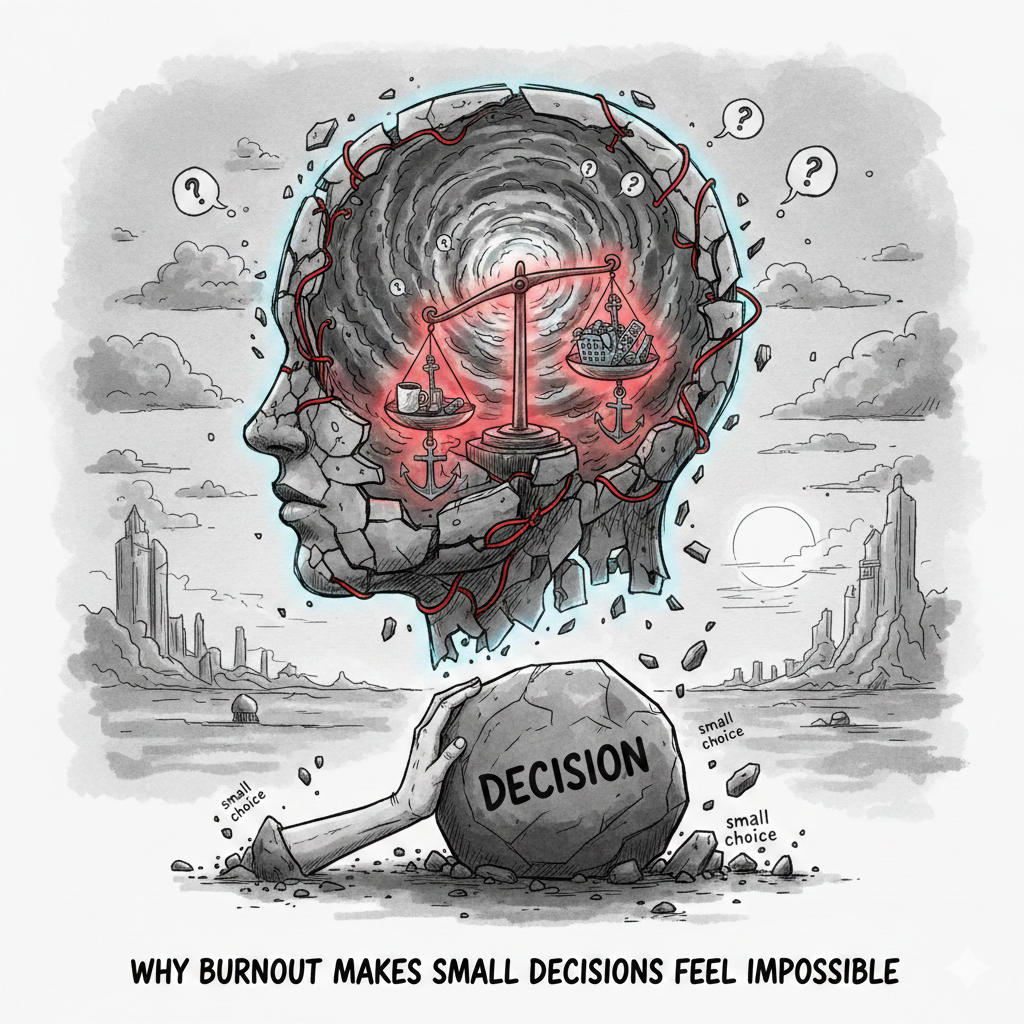
Burnout Reduces Mental Capacity
Burnout drains the mental systems responsible for prioritising, evaluating, and initiating action.
Your brain has limited decision-making energy. When that energy is depleted, even minor choices require effort that simply isn’t available.
This is why small decisions feel impossible during burnout.
The issue isn’t intelligence or capability.
It’s capacity.
Under prolonged stress, the brain shifts into conservation mode. It begins conserving energy rather than wasting it. Decision-making becomes expensive.
Avoidance becomes a survival strategy — not a character flaw.
This is different from temporary stress. If you’re unsure which you’re experiencing, it helps to understand
👉 The Difference Between Stress and Burnout
Stress usually clears with rest.
Burnout lingers.
In burnout, the system remains depleted even when external pressure subsides.
Decision Fatigue and Burnout
When burnout deepens, decision fatigue becomes constant.
People often describe this as:
– Feeling “stuck”
– Taking far longer to start simple tasks
– Avoiding choices altogether
– Wanting someone else to decide
– Feeling irritated by small questions
Every unresolved decision adds mental weight.
What should I cook?
Should I call back?
Is this the right way to do it?
Am I forgetting something?
Each choice competes for limited energy.
Ironically, the more decisions accumulate, the worse it becomes. The brain begins to shut down non-essential processes to preserve function.
From the outside, this may appear to be procrastination.
From the inside, it feels like paralysis.
That’s an important distinction.
Burnout doesn’t look dramatic. It often shows up quietly — in the moment you realise you can’t decide what to eat for dinner.
Burnout Isn’t Laziness
When small decisions feel impossible, people often blame themselves.
“I’m being ridiculous.”
“This shouldn’t be hard.”
“I used to handle more than this.”
But burnout changes cognitive efficiency.
It reduces working memory.
It slows processing speed.
It narrows focus.
It increases mental friction.
The brain under burnout isn’t broken.
It’s overloaded.
This deeper internal shutdown is described more fully in
👉 What Burnout Really Feels Like (And Why Rest Alone Doesn’t Fix It)
Burnout is not simply tiredness. It’s the accumulated strain that reduces the margin.
And when the margin disappears, small tasks expand.
Why Small Decisions Feel So Heavy
Every decision requires:
- Evaluating options
- Predicting outcomes
- Accepting uncertainty
- Taking responsibility
In burnout, uncertainty is perceived as more threatening. Responsibility feels heavier. Risk tolerance shrinks.
So the brain delays.
It waits for clarity that doesn’t come.
It hopes the decision will disappear.
Sometimes it does. Sometimes someone else decides. Sometimes the urgency increases.
However, the internal pressure builds in either direction.
This is why burnout is often accompanied by increased irritability. When someone asks, “What do you want to do?” it can feel overwhelming instead of simple.
Not because the question is hard.
But because the system is already full.
What Actually Helps During Burnout
The goal during burnout is not to restore productivity.
It’s to reduce cognitive demand.
That may mean:
– Narrowing choices (eat the same breakfast every day)
– Creating routines to reduce decisions
– Limiting optional commitments
– Allowing “good enough” decisions
– Letting small things stay undecided
Decision-making improves when pressure reduces.
Small decisions feel impossible, not because you’re incapable — but because you’ve been carrying too much for too long.
Burnout doesn’t announce itself loudly.
Sometimes it shows up quietly — in the hesitation before replying to a message.
In the unopened email.
In the frozen moment in front of the fridge.
When everyday choices feel heavier than they should, it may not be weakness.
It may be depletion.
And depletion warrants reduction—not self-criticism.
According to the World Health Organisation, burnout is linked to chronic workplace stress
According to the World Health Organisation, burnout is linked to chronic workplace stress.
Link “World Health Organisation” to:
https://www.who.int/.
Pingback: The Difference Between Stress and Burnout – modernburnout.com.au
Pingback: The Difference Between Stress and Burnout – modernburnout.com.au
Pingback: Why Small Tasks Feel Like Mountains – modernburnout.com.au
Pingback: Why So Many Mothers Feel Exhausted Even When They’re “Doing Everything Right”