
Why burnout often feels like irritation, not sadness, is something many people don’t understand until they experience it themselves.
Burnout doesn’t always feel heavy, emotional, or tearful.
Often, it feels sharp.
Small things start to annoy you.
Noise feels louder.
Questions feel like interruptions.
People feel demanding — even when they’re not.
You’re not crying.
You’re not lying in bed unable to move.
You’re functioning.
But you’re irritated.
And that’s what makes it confusing.
Many people assume burnout should look like sadness, exhaustion, or visible collapse. But in reality, one of the most common signs of burnout is irritation. The edge. The short fuse. The feeling that everything is “too much.”
If you’ve been asking yourself why you feel constantly annoyed for no clear reason, this may be the explanation.
Irritation Is a Nervous System Signal
Irritation shows up when your internal system is overloaded and has no room left.
When energy is low, patience disappears first.
Your brain prioritises survival. That means conserving energy, reducing inputs, and protecting remaining resources. When something extra enters your space — a question, a request, noise, a decision — it feels intrusive.
Not because it is.
But because you have no margin.
Burnout narrows tolerance.
Things you once handled easily now feel overwhelming. Not because you’ve changed — but because your reserves are gone.
Psychologists describe burnout as chronic workplace or life stress that hasn’t been successfully managed. The World Health Organisation defines burnout as an occupational phenomenon characterised by emotional exhaustion, cynicism, and reduced professional efficacy. :
Note that cynicism and emotional distance are part of burnout. That emotional distancing often shows up as irritation.
Why Burnout Often Feels Like Irritation, Not Sadness in High-Functioning People
Why burnout often feels like irritation, not sadness in high-functioning people is rarely talked about openly. When someone keeps showing up, performing, and handling responsibilities, their exhaustion doesn’t always collapse into tears. Instead, it hardens into tension, impatience, and a shorter emotional fuse.
High-functioning burnout doesn’t remove responsibility. It reduces internal capacity, and when capacity shrinks while expectations remain the same, irritation becomes the visible symptom.
You’re Not Reacting to the Moment — You’re Reacting to the Load
When burnout deepens, your responses no longer align with the situation.
A small inconvenience feels huge.
A simple request feels unreasonable.
Normal noise feels aggressive.
You’re not reacting because something is wrong in that specific moment.
You’re reacting because you’ve been stretched for too long.
Burnout builds slowly. It accumulates through responsibility, pressure, constant output, and the feeling that stopping isn’t an option. Over time, your nervous system remains slightly activated — slightly tense — slightly on edge.
That tension becomes your baseline.
This is similar to what happens when small tasks become overwhelming. If that sounds familiar, you might relate to this:
When internal capacity drops, everything feels heavier.
Irritation Protects What Little Energy Is Left
There’s also guilt that comes with it.
You might think:
Why am I so snappy?
Why can’t I just calm down?
Why am I becoming difficult?
But irritation isn’t a personality flaw.
It’s a signal.
A nervous system stuck in survival mode doesn’t have room for softness. It lacks the energy for emotional flexibility. It’s trying to reduce input and maintain control.
Sadness slows you down.
Irritation pushes outward.
It creates distance.
It protects boundaries — even if clumsily.
Sometimes irritation is the body saying:
“I can’t hold any more.”
That doesn’t make you a worse person. It means your system is overloaded.
Why Burnout Irritation Feels Different from Normal Stress
Stress is usually temporary.
There’s a deadline. A problem. A short-term spike in pressure.
When the pressure passes, your system settles.
Burnout is different.
Burnout lingers. It doesn’t fully reset. Even after a weekend or short break, you still feel tense. Still reactive. Still edged.
If you’re unsure whether what you’re experiencing is stress or something deeper, this explains the difference:
With stress, irritation comes and goes.
With burnout, irritation becomes your personality’s background noise.
You may notice:
- Shorter responses
- Less tolerance for conversation
- Feeling drained after basic interaction
- Increased frustration with loved ones
- A constant low-level edge
This doesn’t mean you don’t care.
It means your capacity is reduced.
The Hidden Shame of Irritation
One of the hardest parts of burnout-related irritation is shame.
Because irritation looks intentional.
It looks like an attitude.
It looks like negativity.
It looks like disinterest.
But internally, it often feels like fragility.
You may actually feel thin-skinned. Sensitive. Easily overwhelmed. But instead of collapsing inward, your system pushes outward.
That outward push feels safer than vulnerability.
And so instead of saying, “I’m exhausted,” you snap.
Instead of saying, “I can’t handle this today,” you withdraw.
Instead of saying, “I’m overwhelmed,” you become sharp.
The irritation is protective.
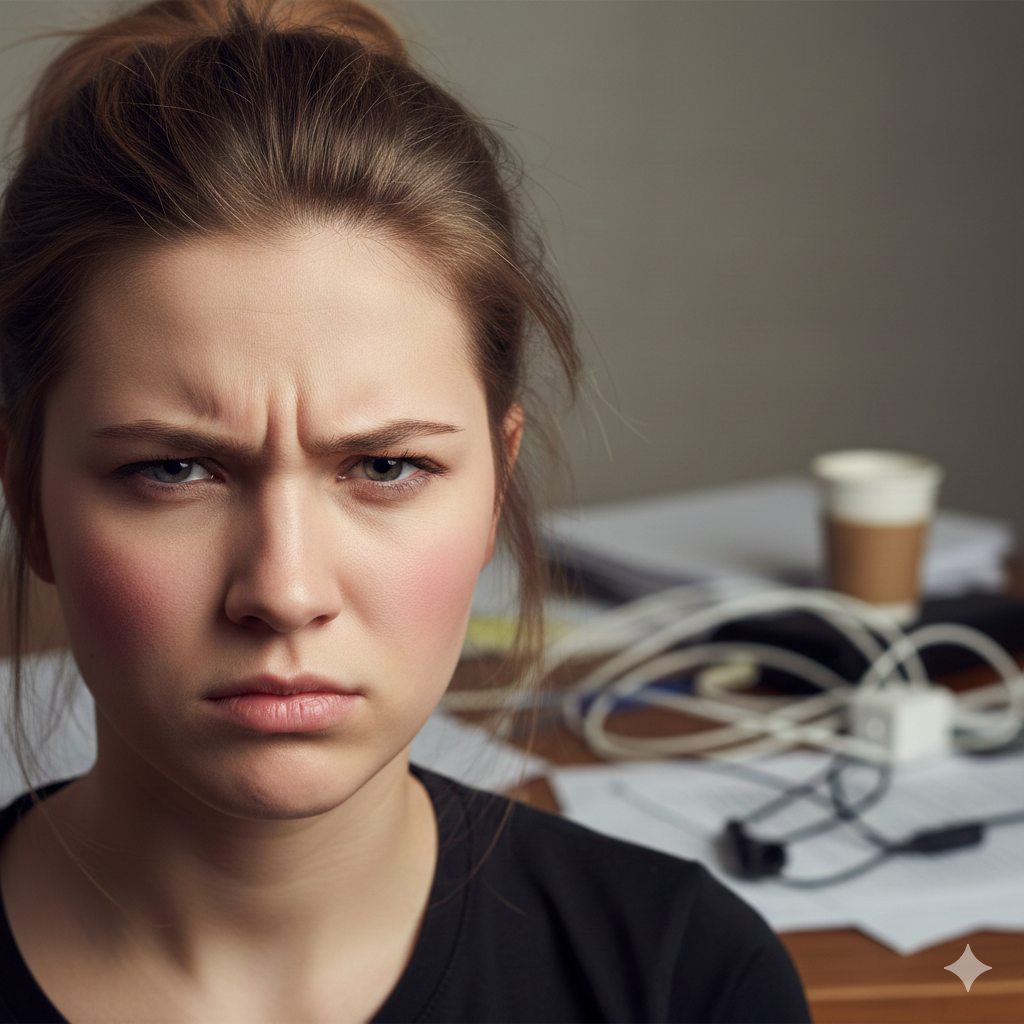
Irritation, Not Sadness
What Actually Helps
Trying to suppress irritation usually makes it worse.
Forcing yourself to “be nicer” without reducing load doesn’t restore capacity.
Burnout recovery isn’t about controlling behaviour first.
It’s about restoring margin.
That might mean:
- Reducing commitments
- Simplifying decisions
- Creating a quiet space
- Saying no earlier
- Accepting temporary limits
Irritation often softens when pressure reduces.
Not because you’ve disciplined yourself.
But because your nervous system finally has room again.
You’re Not Becoming a Worse Person
Burnout doesn’t always look like tears.
Sometimes it looks like short answers, clenched jaws, and a constant edge.
Recognising this matters.
Not so you can manage your reactions perfectly.
But so you stop attacking yourself for having them.
You’re not becoming colder.
You’re not becoming selfish.
You’re not becoming mean.
You’re becoming tired.
And irritation is one way tiredness protects itself.
According to the World Health Organisation, burnout is linked to chronic workplace stress
According to the World Health Organisation, burnout is linked to chronic workplace stress.
Link “World Health Organisation” to:
https://www.who.int/.
Pingback: Burnout Can Exist Even When Life Looks Fine – modernburnout.com.au
Pingback: When Motherhood Leaves You Feeling Like You’ve Lost Yourself - modernburnout.com.au
Pingback: Why Some Fathers Feel Distant After a Baby Arrives (And Why It’s Normal)
Pingback: The Silent Pressure New Fathers Carry (And Rarely Talk About - modernburnout.com.au
Pingback: The Difference Between Stress and Burnout: Why Exhaustion Doesn’t Always Improve With Rest