
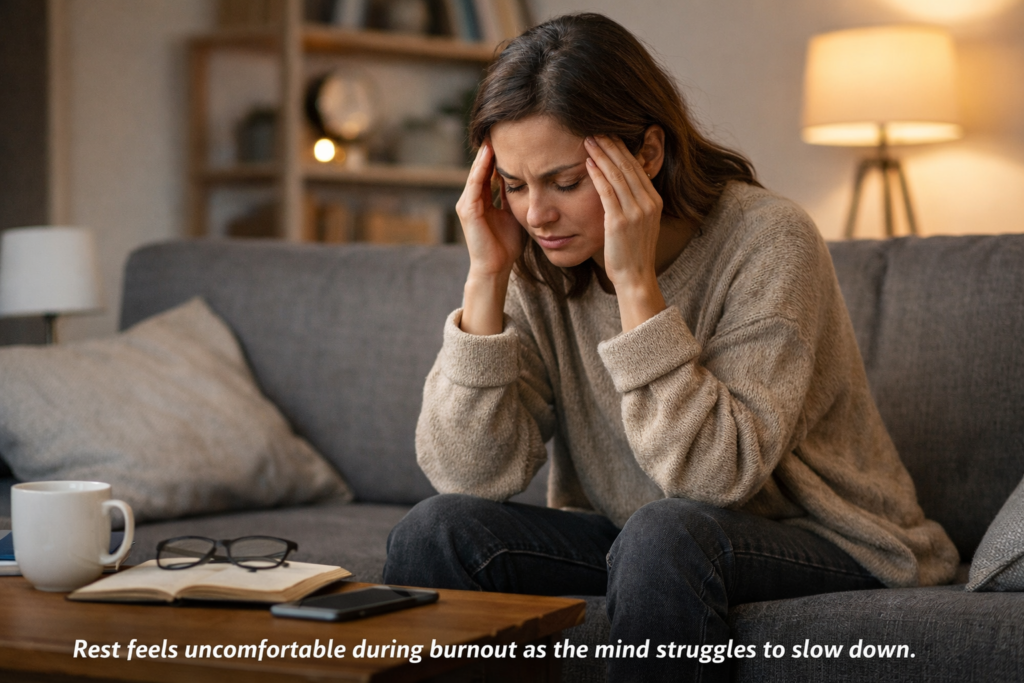
Why Rest Feels Uncomfortable During Burnout?. Rest feels uncomfortable during burnout for many people, even though rest is supposed to help recovery.
Sleep more.
Take time off.
Slow down.
But many people experiencing burnout notice something confusing.
Even when they finally have time to rest, it doesn’t feel relaxing.
Instead, rest can feel:
- Uncomfortable
- Restless
- Guilty
- Anxious
- Mentally noisy
You sit down to relax, but your mind keeps running.
You take a break, but something inside you feels tense or unsettled.
You try to do nothing, yet it feels strangely difficult.
If this sounds familiar, there’s nothing wrong with you.
One of the lesser-known aspects of burnout is that rest itself can feel uncomfortable.
And there are real psychological reasons why.
Table of Contents
Burnout Trains Your Nervous System to Stay “On”
Burnout doesn’t happen overnight.
It builds gradually through long periods of pressure, responsibility, and constant mental load.
Over time, your nervous system adapts to this state of continuous demand.
You become used to:
- Constant problem-solving
- Anticipating tasks
- Managing responsibilities
- Thinking ahead
- Holding multiple worries at once
Your brain becomes trained to stay in a state of high alert.
This state is sometimes called chronic stress activation.
Even when you stop working, your mind doesn’t immediately switch off.
It keeps scanning for things that need attention.
Things you forgot.
Things you should fix.
Things you might be behind on.
Your body may be sitting still.
But your mind is still moving.
That’s why rest can feel strangely uncomfortable.
Your nervous system has forgotten how to settle.
Rest Can Trigger Guilt During Burnout
Another reason rest feels difficult is guilt.
Many people experiencing burnout have spent years being responsible, productive, and dependable.
They are used to being the person who:
- Solves problems
- Shows up for others
- Gets things done
- Carries the workload
Over time, productivity can become closely tied to identity.
Being useful becomes part of how you measure your value.
So when you stop, even temporarily, something inside you may whisper:
You should be doing something.
You’re wasting time.
There are things that still need attention.
This internal pressure doesn’t disappear simply because you’re tired.
In fact, burnout often intensifies it.
Rest can feel like neglecting responsibilities — even when rest is exactly what your body needs.
The Mind Doesn’t Trust Rest Yet
Burnout often develops when people have spent long periods pushing through exhaustion.
They ignore fatigue.
They postpone recovery.
They keep going because responsibilities demand it.
Over time, the brain learns an important lesson:
Stopping isn’t safe.
Stopping means falling behind.
Stopping means letting people down.
Stopping means losing control.
So when you finally try to rest, your brain resists.
It stays alert because it has been trained to believe that rest equals risk.
Instead of relaxing, your mind keeps monitoring things.
Checking.
Planning.
Preparing.
Even during downtime.
Your brain is still trying to protect you.
It just hasn’t learned that rest is allowed yet.
Burnout Can Make Stillness Feel Strange
Another surprising part of burnout is how unfamiliar stillness can feel.
When life has been filled with constant activity, responsibilities, and deadlines, quiet moments can feel almost uncomfortable.
Suddenly, there’s space.
Space in your schedule.
Space in your thoughts.
Space without immediate tasks.
For many people in burnout, that space feels unfamiliar.
It can create a sense of restlessness.
You might notice yourself reaching for distractions:
Scrolling your phone
Checking emails
Watching something in the background
Finding small tasks to do
Not because you want to work.
But because stillness feels strange.
Your mind has become used to constant movement.
Rest Brings Thoughts You’ve Been Avoiding
Another reason rest can feel uncomfortable is that it creates room for thoughts and emotions that were previously pushed aside.
When life is busy, your attention stays focused on tasks.
Work.
Responsibilities.
Deadlines.
Problems.
Activity can serve as an emotional shield.
But when you slow down, that shield disappears.
Thoughts start appearing.
Feelings you ignored start surfacing.
Questions you avoided may show up.
You might start wondering:
Why do I feel this exhausted?
How long have I been carrying this?
Why does everything feel heavier lately?
This isn’t a failure of rest.
It’s actually part of what rest does.
Rest removes distractions.
And that allows your inner experience to become visible again.
Burnout Often Disconnects You From Pleasure
People with burnout often notice something else strange.
Even when they try to relax, things that used to feel enjoyable don’t bring the same feeling anymore.
Watching a movie feels flat.
Reading feels difficult.
Hobbies feel like effort.
Socialising feels draining.
This can make rest feel pointless.
You may think:
What’s the point of resting if I don’t even enjoy it?
But this numbness is actually a common symptom of burnout.
Your nervous system has been running in stress mode for so long that pleasure signals temporarily fade.
This doesn’t mean enjoyment is gone permanently.
It means your system is still recovering.
You can read more about this experience in
Emotional numbness is a burnout symptom
When people understand this, they often feel relief.
Nothing is broken.
Your mind is simply exhausted.
Burnout Makes Your Brain Crave Activity
Burnout creates an interesting paradox.
You feel exhausted.
But your brain still pushes you toward activity.
This happens because your mind has learned that movement equals progress.
Doing something feels safer than doing nothing.
Even small tasks can create the illusion of control.
Answering emails.
Cleaning something.
Organising something.
Checking work messages.
Each action briefly reduces anxiety.
But it also prevents deeper recovery.
This is why many people say they rested all weekend yet still feel drained.
They weren’t truly resting.
Their brain stayed engaged the whole time.
Rest Feels Uncomfortable During Burnout
Rest feels uncomfortable during burnout for many people, even though rest is often recommended as the solution to exhaustion. When someone reaches burnout, their body and mind have usually spent long periods operating under pressure, responsibility, and constant mental activity. The nervous system becomes used to staying alert, solving problems, and anticipating the next demand.
Because of this, suddenly slowing down can feel strange. Instead of relaxation, many people notice restlessness, racing thoughts, or a subtle sense that they should be doing something. The mind keeps searching for unfinished tasks or future problems to solve. Even when the body is physically resting, the brain may still feel active and tense.
Rest feels uncomfortable during burnout partly because the brain has adapted to long-term stress. When the nervous system has been in “high alert” mode for weeks or months, quiet moments can feel unfamiliar. Your mind may continue running through responsibilities, conversations, or worries about what needs to happen next.
Another reason rest feels uncomfortable during burnout is the sense of guilt that often appears when people stop being productive. Many people experiencing burnout are used to carrying responsibilities for work, family, or other people. When they pause, even briefly, it can feel like they are falling behind or letting someone down.
This internal pressure doesn’t disappear immediately when burnout appears. In fact, burnout often makes the mind more sensitive to these feelings. Rest can feel undeserved, even when it is exactly what the body and mind need in order to recover.
Over time, however, this discomfort can slowly change. As the nervous system begins to settle and the constant pressure reduces, the mind gradually relearns how to relax. What feels uncomfortable at first can slowly become restorative again. Rest may not feel easy during burnout, but it remains one of the most important parts of recovery.
Real Rest Requires Mental Permission
One of the biggest obstacles to rest during burnout is internal permission.
Many people wait until everything is finished before allowing themselves to relax.
But life rarely reaches that point.
There is always something pending.
Another task.
Another responsibility.
Another problem.
If rest only happens after everything is done, rest may never happen.
Real recovery requires something different.
It requires allowing rest even when things remain unfinished.
That idea can feel uncomfortable at first.
But burnout recovery depends on it.
Your mind needs to learn that it’s safe to pause.
Why “Forcing Yourself to Relax” Doesn’t Work
Sometimes, people experiencing burnout try to solve the problem by forcing relaxation.
They schedule rest.
Book holidays.
Take time off work.
But the internal pressure follows them.
They sit on the beach checking emails.
They take time off while mentally planning tasks.
They rest physically but remain mentally active.
This can lead to another frustrating experience.
You rest, but still feel exhausted.
That’s because burnout isn’t only physical fatigue.
It’s mental overload.
Your brain needs time to shift out of stress mode.
And that shift doesn’t happen instantly.
Recovery Is Often Gradual
One important thing to understand about burnout recovery is that it doesn’t happen in a straight line.
Some days you feel better.
Some days you feel worse again.
This can make rest feel confusing.
You may wonder why improvement isn’t consistent.
But recovery rarely moves in a simple upward direction.
If you want to explore this more deeply, you may find this helpful:
Recovery isn’t linear: why you feel better than worse
Understanding this pattern helps reduce frustration.
Ups and downs are normal during recovery.
Your system is gradually recalibrating.
Small Rest Is Often Easier Than Big Rest
Another helpful insight is that small moments of rest often work better than long forced breaks.
Instead of trying to completely stop for days, it can help to introduce shorter pauses.
A quiet walk.
Ten minutes without screens.
A slow coffee without multitasking.
Brief periods where nothing is demanded from you.
These moments allow your nervous system to practice settling.
Over time, rest becomes less uncomfortable.
Your brain slowly relearns that quiet moments are safe.
Burnout Changes Your Relationship With Time
Burnout can also distort how you experience time.
When your mind is overloaded, every pause can feel like falling behind.
You may feel pressure to use every moment productively.
Even leisure time becomes something to optimise.
But recovery requires shifting this relationship.
Time doesn’t always need to be used.
Sometimes, time simply needs to pass.
Quietly.
Without pressure.
Without performance.
This can feel strange at first.
But it gradually helps the nervous system decompress.
Learning to Rest Again
One of the most overlooked aspects of burnout recovery is that rest is a skill.
When someone has spent years pushing through exhaustion, they may need to relearn how to relax.
That learning process can include:
Letting go of constant productivity
Reducing mental multitasking
Allowing unfinished tasks to exist
Spending time without stimulation
Allowing the mind to wander
At first, this can feel uncomfortable.
Your brain will likely resist.
But with repetition, rest becomes easier.
Your system slowly remembers how to settle.
The Strange Middle Phase of Burnout
Many people with burnout go through a confusing middle phase.
They’re exhausted enough to need rest.
But not relaxed enough to enjoy it.
This stage can feel frustrating.
You know you need a break.
Yet breaks don’t feel restorative yet.
This doesn’t mean rest isn’t working.
It means your system is still adjusting.
The nervous system needs time to move out of long-term stress patterns.
And during that transition, rest may feel awkward or uneasy.
That phase is temporary.
Rest Is Not Wasted Time
One of the biggest mindset shifts during burnout recovery is learning that rest is not wasted time.
It is a repair.
During true rest, the body performs essential recovery processes:
Stress hormones begin to drop.
Mental overload begins to clear.
Cognitive resources slowly rebuild.
Creativity and emotional balance return.
These processes take time.
And they require space.
Rest may feel unproductive in the moment.
But it is one of the most important forms of recovery your mind can experience.
Burnout Changes Slowly — And So Does Recovery
If rest feels uncomfortable right now, it doesn’t mean it will always feel that way.
Your nervous system is simply adapting after a long period of pressure.
The more often you allow small moments of genuine pause, the easier they become.
Gradually:
Your mind slows down more easily.
Quiet moments feel less threatening.
Pleasure begins to return.
Rest starts to feel restorative again.
This shift doesn’t happen overnight.
But it does happen.
Burnout took time to build.
Recovery also unfolds over time.
And learning to rest again is one of the most important parts of that process.
Link “World Health Organisation” to:
https://www.who.int/.