
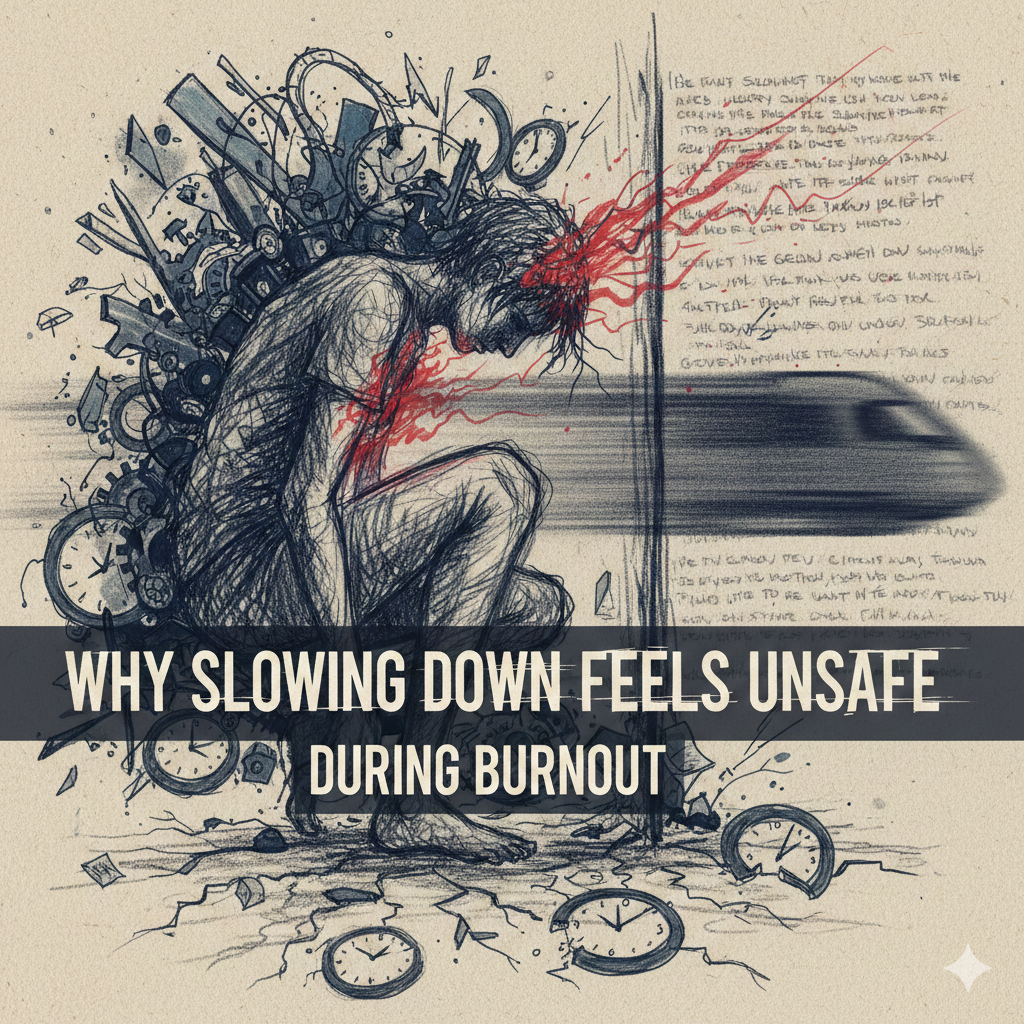
Why Slowing Down Feels Unsafe During Burnout? Slowing down feels unsafe during burnout for many people, even though rest is often recommended as the solution
People often say burnout means you need to slow down.
But during burnout, slowing down can actually feel unsafe.
Instead of relief, it can feel as though you’re exposed.
Anxious.
Unsettling.
If you’re used to functioning at a high level — showing up, performing, managing responsibilities — your identity may be tied to momentum.
Slowing down interrupts that momentum.
For people experiencing high-functioning burnout, responsibility often persists even when internal capacity has disappeared. From the outside, everything may still look stable. Internally, however, energy is collapsing.
This creates a quiet contradiction:
You are exhausted — but you don’t feel allowed to stop.
When you slow down, thoughts get louder.
Questions surface:
- Who am I if I’m not productive?
- What if I fall behind?
- What if I disappoint people?
- What if everything unravels without me?
Burnout often lives inside systems of pressure — work, family, expectations you’ve placed on yourself. If those systems don’t change, slowing down can feel unsafe because nothing else slows down with you.
Your calendar may still be full.
People may still depend on you.
Deadlines may still exist.
So your nervous system stays alert.
The Nervous System Problem
If your body has been in “go” mode for a long time, it adapts to that state. Chronic stress increases cortisol and adrenaline. Over time, your baseline shifts.
Urgency becomes normal.
Pressure becomes familiar.
Constant motion feels stable.
When you suddenly introduce stillness, your body doesn’t automatically interpret it as safety.
It interprets it as unfamiliar.
And the unfamiliar can feel threatening.
This is one reason slowing down feels unsafe during burnout. Your system has been conditioned to equate productivity with security.
Stopping feels like losing control.
When slowing down feels unsafe during burnout, it usually signals a nervous system that has adapted to prolonged pressure.
The Identity Problem
Burnout doesn’t just drain energy. It challenges identity.
Many people who experience burnout are:
- Reliable
- Responsible
- High-performing
- Used to being the “strong one”
Their worth has slowly fused with usefulness.
If your identity is built around endurance, slowing down can feel like erasing yourself.
It can trigger shame.
It can trigger fear.
It can feel like becoming less.
But burnout recovery often requires separating who you are from what you produce.
That separation can feel destabilising at first.
Why Rest Alone Doesn’t Work
This is also why rest doesn’t work when guilt remains.
If you’re lying down but mentally rehearsing what you should be doing, your nervous system doesn’t calm down. It remains activated.
If you’re taking time off but criticising yourself internally, you are not truly resting.
Rest without safety doesn’t restore.
Slowing down isn’t just behavioural — it’s psychological.
It requires your system to believe that nothing bad will happen if you pause.
This is also why rest doesn’t work when guilt is still present — slowing down isn’t just behavioural, it’s psychological.
What Actually Helps
Burnout recovery usually requires a gradual shift rather than a dramatic stop.
Instead of:
“I need to completely shut down.”
It may look like:
- Reducing one responsibility at a time
- Practising shorter periods of intentional rest
- Creating boundaries around availability
- Allowing imperfection without self-punishment
- Rebuilding tolerance for stillness slowly
For some people, slowing down has to happen in layers.
Not a full stop.
More like easing off the accelerator instead of slamming the brakes.
Over time, the nervous system relearns that safety doesn’t require constant output.
When Slowing Down Becomes Neutral
The goal isn’t to love slowing down immediately.
It’s for slowing down to feel neutral.
Not threatening.
Not shame-filled.
Not dangerous.
Just steady.
When slowing down feels steady rather than unsafe, healing usually begins.
Burnout doesn’t mean you’re incapable.
It often means your system has been protecting you for too long.
And learning to slow down safely is part of rebuilding capacity — not losing it.
According to the World Health Organisation, burnout is linked to chronic workplace stress.
Link “World Health Organisation” to:
https://www.who.int/.